Jaguar I‐PACE
Jaguar I‐PACE battery Wiki~
This battery is currently being reverse engineered by @obbardc and Cory Mac - ØY Electrical (along with lots of help from @dalathegreat and other community members).
Battery specifications~
90kWh battery, Model years 2018–2024
Note on Contactor Control~
The battery has the internal contactor coils forcibly controlled by the Battery-Emulator, using the Contactor control via GPIO setting. This is because the CAN control of contactors are not operating yet.
We need to verify if the cells are being properly balanced by the iPace BMS with the contactors forcibly engaged.
We made two videos about the reverse engineering:
- Part 1: Hacking an EV Battery From a £90,000 Car - DIY Vehicle to Grid
- Part 2: Hacking a Scrapped £90,000 EV Battery to get FREE Electricity - DIY Vehicle to Grid - Part 2
Reverse engineering threads/links~
- openinverter - Connecting to standalone BECM including pinouts, UDS PIDs, UDS error codes etc. (by @obbardc)
- openinverter - BMS
- Car PIDs spreadsheet (incl. BECM)
TODO~
- Engage battery contactors by sending the right CAN messages. See Issue: Jaguar iPace Battery Contactors do not yet close for more information.
- Confirm that cells are balanced during operation.
- Poll for all cellvoltages. There does not seem to be a UDS register/CANBUS register for this.
- Different keepalive/other CAN messages for >2021 models.
- LG's pouch cells in I-PACE have a habit of tabs becoming disconnected. This leads to modules becoming 3P rather than 4P. The I-PACE BMS wasn't flagging this in earlier firmware revisions leading to the module becoming overcharged and fires. Determine which models are used.
CAN logs from working vehicle~
BECM~
- BECM CAN ID is 0x7e4, returns data on 0x7ec.
- Appears to be in UDS format.
- Spreadsheet containing UDS PIDs and UDS Error codes
Specifications~
Pictures~
Wiring diagram (low voltage)~
To use the battery, you need to connect 6 wires in total ( 2x 12V signals, 2x GND signals, and CAN-H/L )
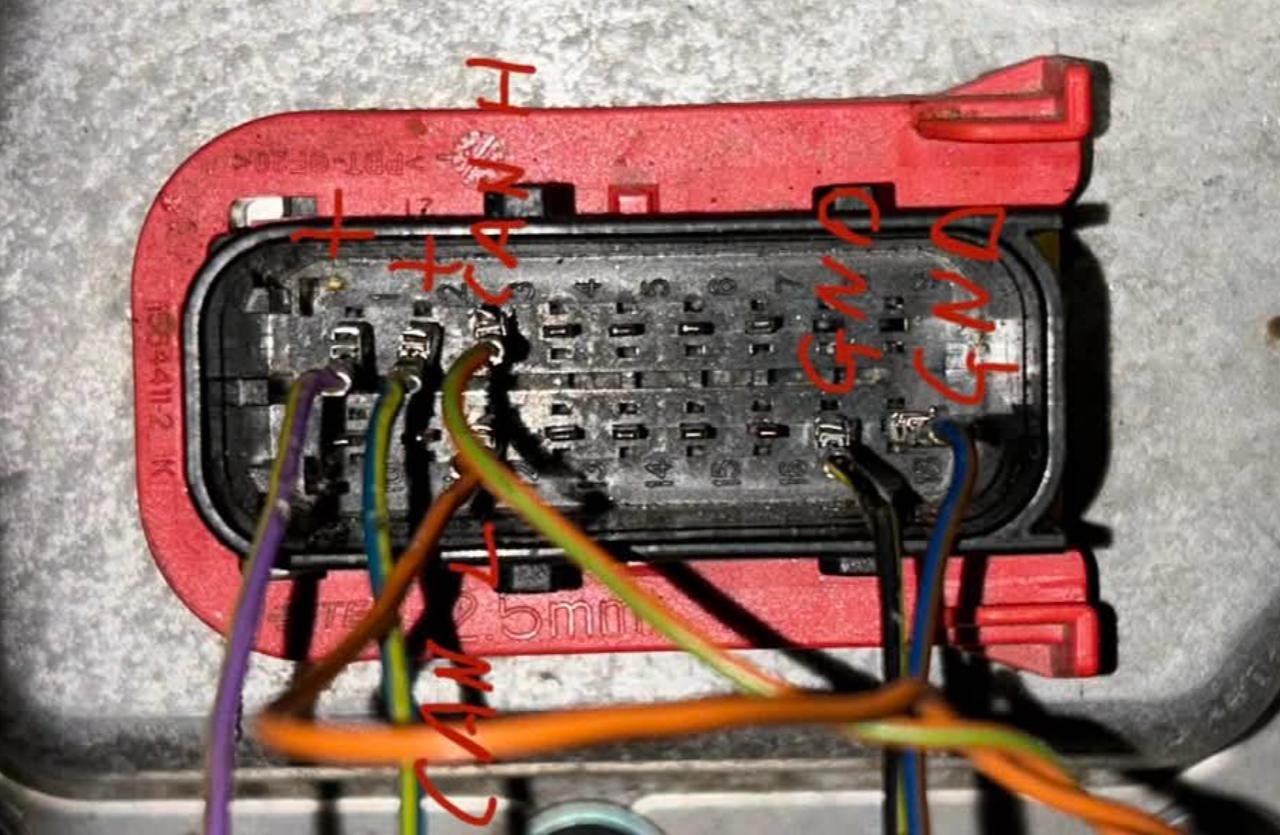
There also seems to be HVIL pins (Pin 7-15, but not confirmed yet if these are required)
High voltage wiring~
- 3x HV connectors with interlocks. TODO: Add diagram.
Software setup~
For this battery type, use the option called "Jaguar I-PACE" under the "Battery Protocol" setting.

Also remember to enable "Contactor control via GPIO" to control the contactors manually.
CAUTION
Working with high voltage is dangerous. Always follow local laws and regulations regarding high voltage work. If you are unsure about the rules in your country, consult a licensed electrician for more information.